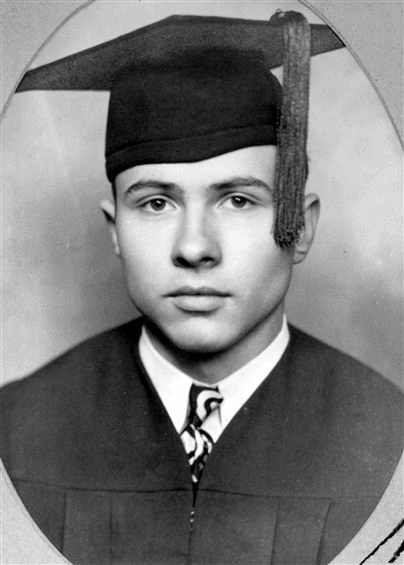
D-Day dog tag makes it home, Soldier died in the sand of
Omaha Beach June 6, 1944
HUNTINGDON - An Englishman picked it up while combing the
beaches of Normandy, France, nearly 60 years after it was
lost in World War II. Ava Clark Smothers welcomed its
return here Wednesday morning and will keep it to pass on
to her family's next generation. The dog tag belonging to
Pvt. William Bernice Clark of Carroll County had been lost
in the sand of Omaha Beach since the young soldier's death
on June 6, 1944. Clark, 20, was killed in the first wave in
the invasion of Normandy, better known as D-Day. The day
marked the start of the Western Allied effort to free
mainland Europe from Nazi occupation. An official with the
National D-Day Memorial Foundation presented the dog tag to
Ava and Lloyd Smothers, Clark's cousins, during a brief
ceremony Wednesday - 63 years to the day of his death.
"It's just a very thrilling experience," Ava Smothers said.
"Well, it's something that happens just once in a lifetime.
I just couldn't believe it was actually happening." The
dog tag was found in 2002 and made its way several thousand
miles to a New Jersey collector of D-Day artifacts. Then on
Monday the D-Day Memorial Foundation in Bedford, Va., got
temporary stewardship of it before it reached the
Smotherses on Wednesday. "Can you imagine a piece of metal
lying in the sand for nearly 60 years, and you can still
read it?" D-Day veteran Tom Meadows said. "... It's just
something very unusual. I just hope they don't find any
more." Meadows was among about 50 people who attended
Wednesday's ceremony. "It sent chills up and down my spine
when I heard about it," said Ron Gilbert, commander of the
Veterans of Foreign War Post 1294 in Lexington. Jeffrey
Fulgham, director of development for the D-Day Foundation,
presented the dog tag to the Smotherses, along with a
letter from Bill Santora of New Jersey. Santora collects
D-Day artifacts. The collector from England who found the
dog tag didn't believe selling it would be the right thing
to do and gave it to Santora, according to the D-Day
Foundation. The idea to give it back to Clark's family
arose when Santora visited the National D-Day Memorial one
day and spoke with Fulgham. Thus began a search for Clark's
family members. At the same time Fulgham was presenting
the dog tag Wednesday, Santora announced at the National
D-Day Memorial in Bedford that the tag had been delivered
to Clark's family. The Smotherses also will receive the
American flag that flew Wednesday at the Memorial.
Huntingdon Mayor Dale Kelley presented a proclamation
during Wednesday's ceremony from the town designating the
day as "Pvt. William B. Clark Day." "This is a pretty
remarkable day, and it's nice that some of his living
relatives are still here to enjoy the day and celebrate the
life," Kelley said. The dog tag ceremony was held at the
War Memorial Monument in Huntingdon's Thomas Park. Clark's
name appears on the local memorial as well as on the one in
Bedford. Thomas Park is also near railroad tracks where
there had once been a train station from which Clark and
other soldiers would have departed for the war. Clark was
part of Company E of the 116th Regiment of the 29th "Blue
and Gray" Division. On D-Day he had been designated to land
on a sector that was a stretch of Omaha Beach, officially
known as Easy Green. But "with strong currents carrying
his landing craft far east and heavy smoke obscuring
landmarks, Clark instead found himself landing on Easy Red,
(the) scene of some of the most intense fighting of the
day," the D-Day Foundation's news release said. Clark was
among the more than 4,000 Allied soldiers killed that day.
He was buried in the American Cemetery near Colleville,
Normandy. Ava Smothers described Clark, her first cousin,
as a kind man who was friendly and outgoing and "just a
good Christian boy." Ava's husband, Lloyd Smothers, is
also a cousin of Clark's through a different family. Clark,
Ava and her sister Lota Park were reared together in the
country and were all more like siblings than cousins, Park
said. Their fathers were brothers. Park said her cousin
also had a sense of humor. She called him by his middle
name. "Bernice was such a nice person," Park said. "...
This was just fitting for Bernice." Fulgham said
Wednesday's event was the highlight of his work with the
D-Day Foundation. "This is what we're about ...," Fulgham
said. "This is the first time we've been able to send a dog
tag, that I'm aware of, to surviving family members. It's
very special, and to be able to do it on the 63rd
anniversary of D-Day, which is also the 63rd anniversary of
his death, is also very significant."5 6 7
Sources:
- Ancestry.com. U.S. WWII Draft Cards Young Men, 1940-1947
- William B. Clark Death Notice
- American Battle Monuments Commission, http://www.abmc.gov/home.php
- Ancestry.com. U.S., Headstone and Interment Records for U.S. Military Cemeteries on Foreign Soil, 1942-1949
- The Jackson Sun, 7/NEWS01/706070311
- William's Dog Tag and Photograph
- Letter From England